Stumbling Blocks and Foundation Rocks
The Rev’d Devin McLachlan
30 August 2026
The Thirteenth Sunday after Trinity
Romans 12.9-end, Matthew 16.21-end
A favourite family story growing up was about when my sister Kate first learned to ride a bike. Excited but terrified, she got on her brand new bicycle with its training wheels (stabilisers) and set off down the path in the park — shouting at the top of her lungs “I’m gonna hit a twee, I’m gonna hit a twee, I’m gonna hit a …”
And sure enough, that’s when she steered right into the tree.
It was, in her worried mind, all that she could see.
Last week —
or rather, just a line or two earlier in Matthew’s Gospel —
Peter was the rock on which Jesus will build the church.
But how quickly this rock has become a stumbling block!
While the stone the builders rejected has become the cornerstone,
has this foundation stone become nothing more than a trip hazard?
Of course, the wordplay doesn’t quite work in Matthew’s original Greek —
Simon is first Petra (πέτρᾳ), the Rock on which Jesus builds the Church,
and then he is skandalon (σκάνδαλον).
That’s where the word ‘scandal’ comes from,
and it means a trap prop,
the bent stick which springs a snare.
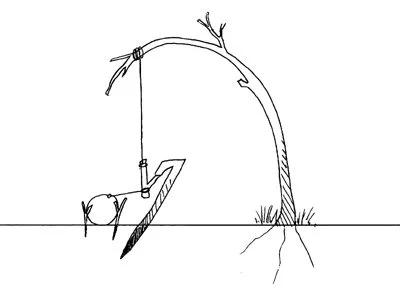
You can blame Tyndale for ‘stumbling block’;
(you can blame Tyndale as well for words like
‘atonement’, ‘scapegoat’ and even ‘intercession’
we might get to see a Tyndale bible at the end of October on Bible Sunday.)
A stumbling block meant the tree root that winds across a footpath,
ready to trip you up and cause you to stumble.
Because of course, ‘block’ used to mean a bit of wood.
Peter may have been the stone on which Jesus would found the church,
but he was also a blockhead.
Scandal was first used in English in the 13th century "Ancrene Riwle”,
a guide for anchoresses such as Julian of Norwich
(there’s a copy of it in the Parker Library);
it specifically meant to "discredit to religion resulting from bad behaviour by a religious person”
Before the invention of the tabloid press,
scandal first and foremost was a question of religion.
And within a few breaths of Jesus’ first mention of the Church,
the church had fallen into scandal.
Not the scandals of future generations,
of cupidity, avarice, abuse.
It was the oldest scandal of all:
For they hid from the Lord, for they were afraid [Genesis 3.8-10, para.]
Fear.
Fear of Death.
You will not surely die, said the serpent. [Genesis 3.4]
And so we first fell.
Peter was so terrified of the Roman tree of death,
that it was all that he could see,
like my sister on her bicycle.
“God forbid it, Lord! This must never happen to you!”
That tree of the fear death loomed so large in his imagination
that he runs headlong into it;
the wood of the cross had becoming a stumbling block.
But Jesus was raised by a carpenter,
and he knew what beauty could be carved from lifeless wood.
This stumbling block,
this snare of empire and death,
this Roman tree of torture,
could be embraced and transformed into no less than the Tree of Life:
“and those who lose their life for my sake will find it.”
We are at a moment in history where there is a great deal to be afraid of:
The man in charge of five thousand nuclear warheads
has decided international diplomacy
consists of renaming Lake Ontario as Lake America.
The extreme weather across Europe this summer,
and the heartbreaking and devastating flash floods in Nepal and Tibet,
are just two of many examples of the cost of human-driven climate change.
We carry personal fears as well —
You may be facing fractured relationships, declining health,
the struggle to find meaningful — or any — work,
or just that sense of looming dread that grabs you by the ankle
right as you’re trying to fall asleep.
Fears that make it hard to follow Paul’s invitation to
“Rejoice in hope, be patient in suffering, persevere in prayer,” [Rom. 12.12]
Some days for some of you, those fears might feel like an awful lot.
I know it sometimes did for St Peter ,
and to the other women and men
whom Jesus called not only disciples but also friends.
And because Jesus loved them — and us —
so dearly, so perfectly and abundantly and extravagantly,
he didn’t want them — and doesn’t want us —
to be burdened by our fears.
For when we are afraid,
we begin to worship that which we fear.
It becomes the tree of death, until it is all that we can see.
But Jesus, that morning outside of Caesarea Philippi,
and in our Gospel today,
and in our hearts each morning,
shows us more than the crucifixion.
He shows us the resurrection,
‘the son of man..raised on the third day,’
I’ve read this Gospel for years, and had never noticed that —
in that moment Jesus didn’t just talk about his death, but also his ressurection.
Peter missed it too. As soon as he heard about the cross, he could hear nothing more. That’s all he could see.
But Jesus shows us new life, the coming of the Kingdom:
the just and the loving reign of God on this earth.
Take up your cross and follow me, he asks of us.
Don’t be a stumbling block and a snare to yourself,
taking up the tree of death,
the fears of the powers and principalities of this world.
Deny the mean self, the ego ruled by fear,
ensnared in the false pride and empty posturing of this world,
ensnared in the fear that we are too small, too frail, too inconsequential
to help bring about the Kingdom of God.
to speak up for justice,
to share with the world the love of Christ.
Set all those stumbling blocks down,
every snare that ties you to fear
– set down pride, set down avarice, set down anxiety, set down self-loathing –
Our hands must be empty of all those things,
if we are to pick up the cross and follow Jesus.
May that be our prayer this week, amidst all the noise of the world:
that our hands might be empty of all ego, all fear,
all anger, greed, and oppression,
in order to bear that easy yoke,
that burden of light:
the love of our saviour Jesus Christ.